
Review · HIGH-SPEED AND BULLET TRAINS
Pompeii & Herculaneum Guided Tour – High Speed Train from Rome
Pompeii and Herculaneum tell the same disaster in two very different ways. Pompeii is huge and theatrical, with broad streets, theaters, baths, and grand homes. Herculaneum is smaller, quieter, and often more intimate, with vivid mosaics, wall paintings, and wooden details that survived the eruption.
I like two things here: the high-speed train removes the headache of planning a Rome to Naples day trip, and the archaeologist guide gives the ruins meaning instead of leaving you to puzzle over broken walls. The planned stop at Maximall Pompeii also gives your feet, water bottle, and camera a useful break.
The catch is the pace. You spend about 11.5 hours on the go, much of it walking over ancient, uneven roads. Pompeii is so large that even a well-planned visit can leave you wishing for more time, and an early train departure means you may return to Naples before you feel completely finished.
Key points at a glance
- High-speed rail from Rome: You travel from Rome Termini to Naples on your own, then meet the tour team across from Naples Central Station.
- Two archaeological sites in one day: Pompeii gives you scale and public life, while Herculaneum offers remarkably preserved houses, mosaics, and timber.
- Archaeologist-led touring: Guides such as Michele, Alfredo, Raphael, Roberta, Gennaro, and Carmine have led this route, with a strong focus on daily Roman life and excavation.
- Small-group format: The maximum group size is 20 people, with headsets supplied so you can hear the guide while walking.
- A planned indoor pause: The 50-minute Maximall Pompeii stop provides restrooms, air conditioning, food options, and a welcome kit with a discount card.
- Serious walking required: Bring supportive shoes, water, sun protection, and patience for uneven paving and a full day on your feet.
Why the train connection makes this day possible
The day begins at Rome Termini, not with a group departure but with an independent train journey. Your high-speed rail tickets are sent one day before the tour, and you board the train yourself. The guide does not meet you in Rome.
That arrangement is simple once you understand it. You need to find your train, keep your ticket and identification handy, and get off at the correct Naples stop. One practical warning is especially useful: Naples has more than one station stop on some train routes, so check the ticket carefully and wait for Napoli Centrale, where the group connection takes place.
At Naples Central Station, walk to Starhotels Terminus in Piazza Giuseppe Garibaldi, directly across from the station. This is the meeting point for the local guide and the Askos Tours driver. The transfer to the archaeological sites is handled by minibus, so you do not need to work out regional trains, taxis, or local buses.
This setup is one of the tour’s best features. A self-planned Rome to Pompeii trip can involve several connections and a lot of timetable checking. Here, the long-distance rail portion and the local transfer are arranged for you, while still allowing the fast train to make the Rome connection practical.
The return works in reverse. After Herculaneum, the minibus brings you back near Naples Central Station, and you board your high-speed train to Rome independently. Allow extra attention at this point. The group aims to get you back in good time, but you are still responsible for finding your platform and boarding your train.
More High-Speed Trains in Italy
- Rome to Pompeii Guided Tour with Wine & Lunch by High Speed Train
★ 5.0 · 1,379 reviews - Rome: Pompeii Tour with Wine and Lunch by High Speed Train
★ 4.8 · 485 reviews - Venice Day Trip from Rome by High-Speed Train with Happy Hour
★ 4.5 · 445 reviews
Pompeii begins at Porta Marina
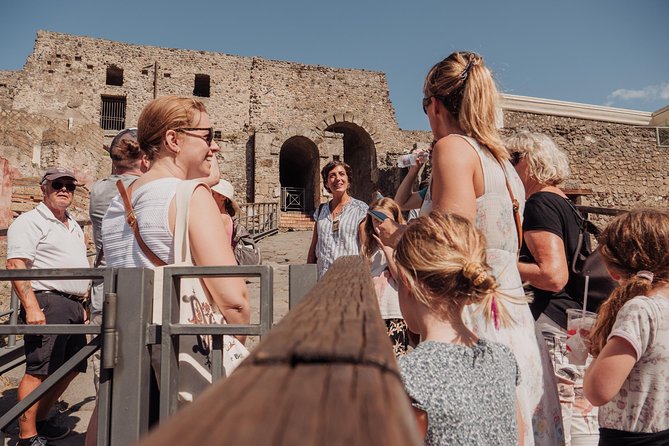
The Pompeii visit starts at Porta Marina, one of the ancient city’s major entrances. This is a fitting way in, since the gate leads quickly into the scale of the old town and helps your guide explain how Pompeii was organized before the eruption of 79 AD.
Expect the archaeologist to set the scene first: streets, homes, businesses, public buildings, and the routines of ordinary residents. The strongest part of this tour is not simply seeing old stone. It is learning how to read the remains. A doorway, water channel, painted wall, or raised pavement can say a great deal when someone explains its purpose.
The route includes Via dell’Abbondanza, Pompeii’s best-known street. Walking here gives you a sense of movement through the city, from private houses to public spaces and commercial areas. The ancient road surface is uneven, so you will want shoes with a firm sole rather than thin sandals.
The House of Menander is one of the notable homes on the route. It helps show the scale and decoration available to wealthy residents. Nearby, the Forum granaries hold another kind of story. They are connected with the city’s public center and the objects recovered during excavation, giving you a clearer link between the ruins and the people who used them.
Pompeii’s baths, brothel, and theaters

The Stabian Baths show how public bathing formed part of Roman urban life. Your guide can point out the arrangement of rooms and explain how the baths functioned as social places as well as facilities for washing.
The Lupanar, Pompeii’s famous brothel, is a brief but memorable stop. Its small rooms and wall paintings are often discussed because they reveal a less polished side of Roman daily life. This is not a stop for children who are uncomfortable with adult themes, although the tour presents it as part of the city’s history rather than as a spectacle.
The House of the Faun shifts the mood back to large-scale domestic architecture. It is one of Pompeii’s most important residences, and its size helps explain how sharply life differed between an elite household and a modest street-level home.
The Odeon, or Small Theatre, and the Great Theatre show Pompeii as a city of entertainment. The smaller venue suggests more intimate performances, while the larger theater gives you a sense of public gatherings and civic life. These stops add variety after a series of houses and streets.
I especially like the way the two archaeological sites complement one another. A guide such as Alfredo or Raphael can use Pompeii to explain the city’s broad layout and then make Herculaneum feel different, rather than simply repeating the same lecture in a second location.
The Maximall break is practical, not archaeological
After the Pompeii portion, the group pauses for about 50 minutes at Maximall Pompeii. It is the largest shopping center in southern Italy, and the tour provides an exclusive welcome kit and discount card for participating stores.
You should think of this as a practical intermission, not part of the ancient-site experience. The break offers a chance to find food, use the restrooms, sit in air conditioning, and recover before another archaeological visit. Meals and drinks are not included, so budget for your own lunch or snack.
Some people may find the shopping-center stop a strange contrast with Pompeii. I understand that reaction. Still, after walking across sun-exposed streets and rough paving, a modern indoor pause can be welcome. It also avoids forcing you to eat hurriedly inside the archaeological park.
Same line, a different day out:
- From Milan: Lake Como Cruise, St. Moritz & Bernina Red Train
★ 4.6 · 5,648 reviews - From Milan: Bernina Train and St. Moritz Day Trip
★ 4.5 · 4,495 reviews - Bernina Red Train, Swiss Alps & St Moritz From Milan
★ 5.0 · 2,954 reviews - Swiss Alps Bernina Red Train and St.Moritz Tour from Milan
★ 4.5 · 2,369 reviews
Herculaneum shows a different kind of preservation
Herculaneum follows the break, with about two hours in the archaeological park. It is smaller than Pompeii, which makes the visit feel more contained. The buildings often retain a stronger sense of interior life, with mosaics, frescoes, wooden elements, and decorated rooms offering a closer look at Roman homes.
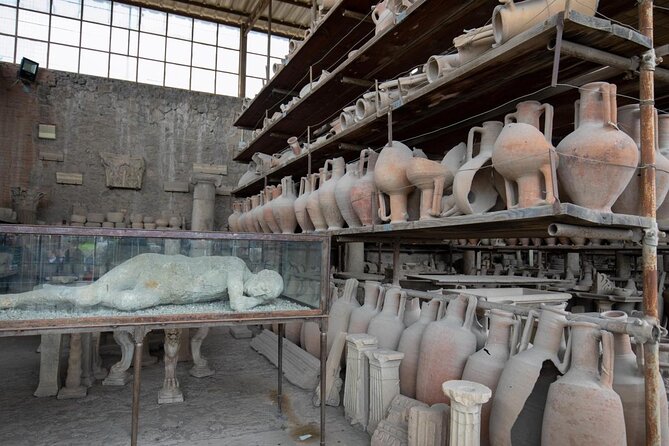
The House of the Wooden Partition is a particularly useful stop because its preserved timber detail is a reminder that Roman buildings were not made only of stone. The House of the Skeleton adds a darker note, while the Central Baths show the familiar Roman interest in bathing and public facilities.
The House of the Relief of Telephus and the Samnite House broaden the architectural picture. You will see different layouts, decorative styles, and signs of social rank. The House of the Fine Courtyard and the House of the Grand Portal continue that look at domestic space, with courtyards and entrances that help you imagine how residents moved through their homes.
The House of the Black Salon, also referred to as the Salon of Nero, is another chance to see how wall decoration shaped a Roman interior. Herculaneum’s preserved details can feel more immediate than Pompeii’s larger streets and open spaces. If you prefer mosaics, frescoes, and rooms you can study closely, you may find Herculaneum the day’s favorite.
The Terrace of Marcus Nonius Balbus and the College of the Augustales add public and religious context. Together, these stops keep Herculaneum from becoming only a tour of private houses. You get a broader sense of how the town functioned and how status, worship, and civic life fit together.
What the archaeologist adds
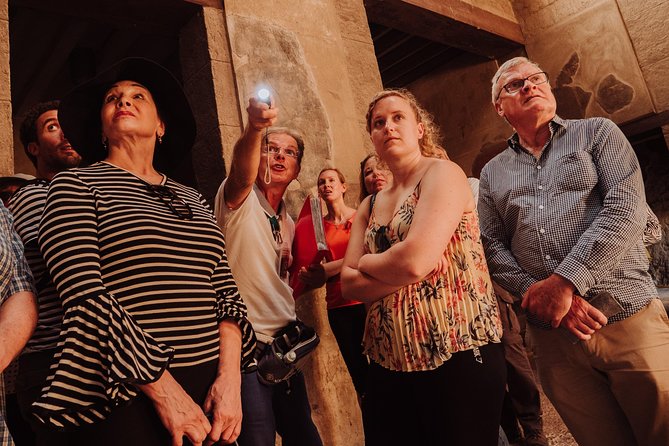
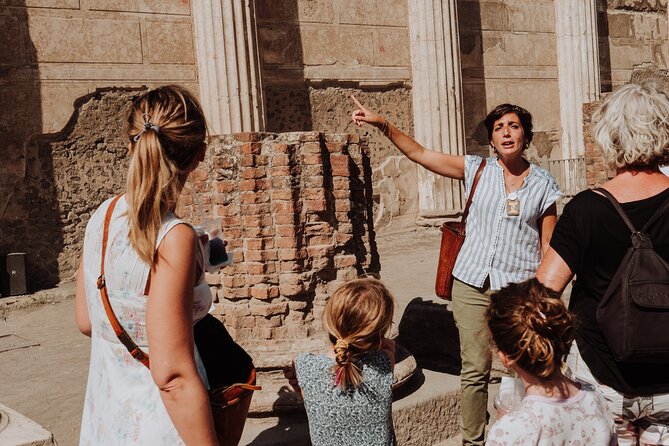
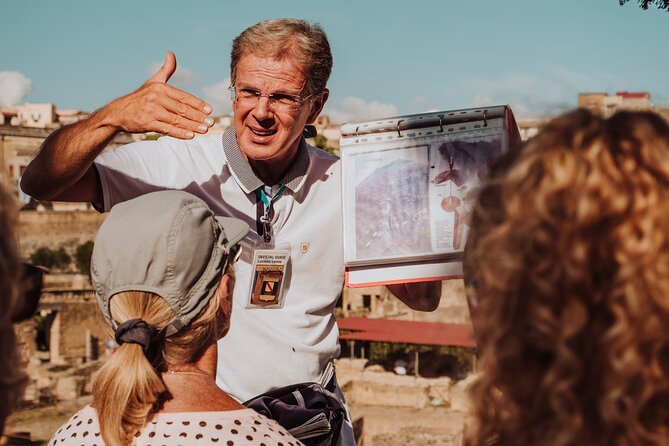
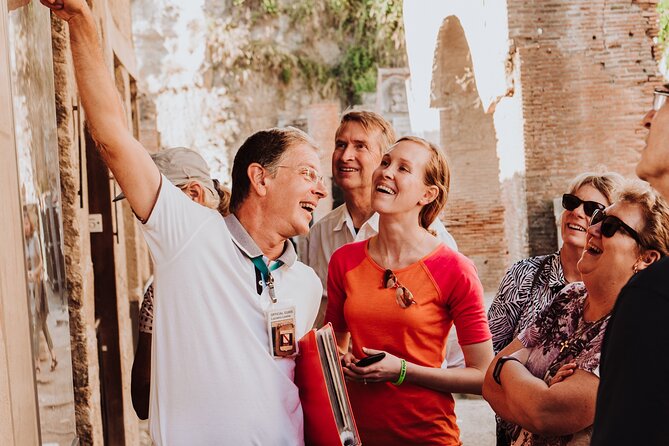
The guide is the key reason to choose this tour instead of buying entry tickets and wandering alone. Several guides have led the route, including Michele, Alfredo, Raphael, Roberta, Gennaro, Carmine, Bruno, and Diego Michelle. The exact guide is not guaranteed, but the strongest accounts describe an archaeologist who explains excavation, geology, Roman customs, and the human stories behind the buildings.
That approach matters at Pompeii. Without context, a long row of walls can blur together. A good explanation helps you notice a shop threshold, a painted room, a bath arrangement, or the difference between a public building and a private villa.
The headsets are another useful touch. Pompeii can be noisy, and the guide may walk ahead while the group spreads out. Headsets let you keep looking at the ruins instead of standing shoulder to shoulder around the guide. One caution is worth keeping in mind: equipment only helps if the volume and connection work properly, so tell the guide promptly if the sound cuts out.
Group management can affect the experience. The maximum is 20 people, which is manageable but not truly private. A few people may walk more slowly, stop for photos, or ask for special sites. The guide has to keep the group moving, especially with a train to catch later.
How much value do you get for $204.38?
The price is $204.38 per person. That includes round-trip high-speed rail from Rome, Pompeii and Herculaneum entry, the Naples minibus transfers, an archaeologist guide, headsets, and the Maximall welcome kit and discount card.
The value is strongest if you are staying in Rome and want both sites in one day without arranging the route yourself. High-speed rail, local transport, admission fees, and guiding would take time to organize separately. The tour also removes the risk of arriving at Pompeii without a timed entry or missing a connection between the two parks.
The price is less compelling if you want a slow, independent archaeological visit. Pompeii alone can occupy most of a day, and this schedule cannot cover every street, villa, or newly reopened area. One person who knew Pompeii well found the visit too limited compared with an earlier, longer visit.
You also pay for convenience rather than luxury. This is a long shared day, not a private car tour. The minibus makes the transfers easier, but your experience depends partly on the pace and attention of the group.
Who should book this tour?
I would choose this for a first visit to both sites, especially if you are based in Rome and have only one free day. It suits adults, families with older children, and anyone who wants historical explanation without spending hours planning regional transport.
It is also a good fit for people who normally prefer independent sightseeing but want help at a complicated archaeological site. The guide can show you what you would likely miss alone, while the headsets give you some freedom to look around.
Think twice if you have knee, hip, or leg problems. The ancient roads are uneven, the day is long, and the two sites together demand stamina. The experience is not recommended for visually impaired participants unless accompanied by a dedicated personal assistant.
Pack light. Suitcases may not fit in the minibus because not every vehicle has a luggage compartment. Store larger bags at the station or another luggage facility before meeting the group. Bring a valid passport or identification, water, sun protection, and comfortable shoes.
Cancellation is free up to 24 hours before the start time for a full refund. Changes or cancellations inside that window are not accepted.
FAQ
Where does the tour begin?
You begin independently at Rome Termini Station for the high-speed train to Naples. The guide does not meet you in Rome.
Where do I meet the guide in Naples?
Meet the local guide and Askos Tours driver at Starhotels Terminus in Piazza Giuseppe Garibaldi, across from Naples Central Station.
Are the train tickets included?
Yes. Round-trip high-speed train tickets between Roma Termini and Naples are included and are sent one day before the tour.
Are Pompeii and Herculaneum admission tickets included?
Yes. The tour includes Pompeii Express entry tickets and Herculaneum ruins entry tickets.
Is lunch included?
No. Meals and drinks are not included. The 50-minute stop at Maximall Pompeii gives you time to arrange food and use the restrooms.
How large is the group?
The activity has a maximum of 20 participants. Headsets are provided for the guided visits.
Can I bring a suitcase?
Large luggage is not recommended. The minibus may not have room because not all vehicles include a luggage compartment, so use a luggage deposit at the station or another facility before the excursion.
Should you book it?
Book this tour if you want to see both Pompeii and Herculaneum from Rome in one organized day, and you value an archaeologist’s explanation more than free time to explore every corner. The train, Naples transfer, skip-the-line entry, and focused guiding make a complicated day workable.
Skip it if your main goal is an unhurried, exhaustive Pompeii visit, or if walking for several hours on uneven roads will be difficult. For most first-time visitors with good mobility, though, the combination is hard to arrange as smoothly on your own. The day moves quickly, but it gives you two strikingly different views of the cities destroyed by Mount Vesuvius in 79 AD.
Just added for rail travellers in Italy
- Genoa: Guided Panoramic City Tour with Funicular★ 4.8 · 24 reviews
- Lake Como: Easy Mountain Trek with Funicular & Boat Ride★ 4.7 · 24 reviews
- Lake Como, Swiss Alps and Bernina Train From Milan★ 4.5 · 86 reviews
- From Rome: Pompeii and Herculaneum Tour w/ High-speed Train★ 4.8 · 92 reviews
- Pompeii & Herculaneum by Train from Rome with Pizza Lunch★ 5.0 · 91 reviews
- Capri: DIY Day Trip with Blue Grotto, Funicular & Lunch★ 4.3 · 129 reviews
- From Rome: Florence & Tuscany Day Tour by High-Speed Train★ 4.6 · 126 reviews
- From Rome: Pompeii and Herculaneum by High-Speed Train★ 4.9 · 132 reviews
High-Speed and Bullet Trains, compared.

Mt Fuji & Hakone Cruise, Drum Show Bullet Train 1 Day from Tokyo
Read our review →
Tokyo Mt Fuji 5th St & Hakone Cruise Bus Tour w/Bullet Train
Read our review →
Taj Mahal & Agra Tour by Gatimaan Express Train
Read our review →
Pompeii Tour with Wine and Lunch by High Speed Train
Read our review →
Venice Day Trip from Rome by High-Speed Train with Happy Hour
Read our review →
Mt. Fuji and Hakone Day Trip From Tokyo with Bullet Train Option
Read our review →
Suzhou Private Day Trip from Shanghai with Bullet Train Option
Read our review →
Browse the lists this tour appears in