
Review · 3-DAY EXPERIENCES
Enjoy 3 days Aswan,Luxor,Abu Simbel,Nubian village,Balloon&train from Cairo
The most memorable part of this Egypt trip is the range packed into a few days. You move from a Nubian village and the First Cataract at Aswan to Abu Simbel, then on to Luxor’s tombs and temples, with a sunrise hot-air balloon flight above the west bank.
I like the practical design: first-class overnight trains save you two long daytime journeys, and the private format lets your own group move with a guide rather than follow a large bus. I also like the human side, especially the Nubian family visit and lunch in a local Egyptian home.
The trade-off is the schedule. The Abu Simbel pickup is around 4:30 a.m., the balloon morning begins around 5:00 a.m., and the final day ends with an overnight train to Cairo. You gain a lot, but you need to be ready for short nights and long sightseeing days.
Key points before you book
- Three major stops in one route: Aswan, Abu Simbel, and Luxor are linked without backtracking.
- Two overnight train rides: The route runs Cairo to Aswan, then Luxor to Cairo, with first-class tickets included.
- Two four-star hotel nights: You spend one night in Aswan and one in Luxor, both with breakfast.
- A rare view of Luxor: The hot-air balloon flight lasts about 35 to 45 minutes over the west bank.
- Local contact matters: You visit a Nubian family and have lunch and tea in an Egyptian home in Luxor.
- Budget carefully: Entrance fees and tips are not included in the $685 price.
Why this Cairo to Luxor route works
This is not really a three-day trip in the way most people count days. It is a five-day journey, with three main sightseeing days wrapped around two overnight train rides. That distinction matters when you plan your Egypt schedule.
You leave your Cairo or Giza hotel at about 7:00 p.m., depending on its location, and ride to Cairo train station. The first overnight train takes you south to Aswan. After touring Aswan and Abu Simbel, you take a daytime train to Luxor, spend the night there, tour Luxor the next day, and catch another overnight train back to Cairo.
I like this setup because you do not burn two full days sitting in a vehicle. You also avoid arranging separate domestic transport between the cities. All the main transfers are handled, including pickup from your hotel, station transfers, local touring, and the final ride back to your hotel or the airport in Cairo.
The catch is comfort. Overnight trains can be a useful time-saver, but they are still train journeys rather than hotel rooms. Your two proper hotel nights are in Aswan and Luxor. If you sleep lightly, the tight schedule may feel more demanding than the price suggests.
The tour is private, so only your group takes part. That gives you a more personal setting and should make it easier to ask questions or adjust the pace within the day’s fixed plan. An Egyptologist guide accompanies the sightseeing, with local guides joining in Aswan and Luxor.
More Balloon Flights in Egypt:
Aswan begins with a Nubian boat trip
After arriving in Aswan, you meet your local guide and take a motorboat along the Nile to Nubian Village. The route passes the First Cataract, a stretch of river known for its rocks and islands, and heads toward the west bank near Soheil Island and the Aswan Dam.
This is one of the most useful parts of the tour because it gives you a look beyond royal monuments. You visit a Nubian family, learn about daily life and local customs, and have time for photographs. The village visit is not just a quick boat stop. It is meant to connect the river, the community, and Nubian culture.
You should keep an open mind about the pace and style of this visit. The schedule describes a chance to meet a family and learn about its way of life, but it does not promise a long workshop or a formal cultural program. Think of it as a personal encounter added to a monument-heavy route.
Afterward, you transfer to your Aswan hotel for a short rest before lunch at a local restaurant. That pause is welcome, especially after the overnight train. Breakfast at the hotel is included, and lunch in Aswan is also covered.
High Dam and Philae Temple by motorboat
The afternoon turns to two major Aswan sights: the High Dam and Philae Temple. The dam is a large modern engineering project that changed the flow of the Nile and helped control flooding and electricity production. The stop gives you a useful piece of modern Egyptian context before you return to the ancient world.
You then take a motorboat to Philae Temple. The water approach is part of its appeal. The temple complex sits on an island, and arriving by boat makes the setting feel separate from the city. Philae is associated with the goddess Isis and is known for its carved columns, courtyards, and reliefs.
Your guide is especially helpful here because the carvings can look like a wall of symbols without explanation. Ask your guide to point out the scenes and explain how the temple was moved to higher ground after the area was affected by the dam. That detail helps you understand why the boat ride is part of the story, not just a transfer.
You spend the night in a four-star Aswan hotel with breakfast. The exact property is not specified, so you should treat the four-star category as the promise rather than expect a named hotel in advance. The available feedback praises the hotels as good four-star properties, along with the food and guides.
Abu Simbel requires an early alarm
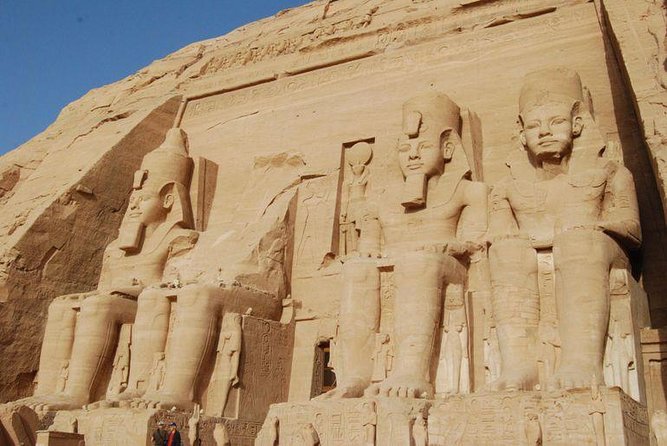
The Abu Simbel trip begins around 4:30 a.m. This is the hardest wake-up of the route, but the reward is one of Egypt’s most dramatic temple complexes. The journey takes you to the rock-cut temples built for Ramesses II and Queen Nefertari.
The temples are famous for their giant seated figures and carefully planned interior chambers. Ramesses II’s temple makes a strong first impression, while the smaller temple dedicated to Nefertari is notable for its statues of the queen alongside the king. Your guide can help separate the political message from the religious scenes carved inside.
The tour description does not give the exact driving time, so you should ask the operator for the current transport details before departure. What is clear is that this is a very early excursion from Aswan, followed by a return for lunch at a local restaurant.
That early start is the main drawback of Abu Simbel. You will have already spent a night on the train, then toured Aswan, and now you are leaving before sunrise. Still, if you have only one chance to see southern Egypt, Abu Simbel is usually the stop I would protect first.
After lunch, you transfer to Aswan station for the train to Luxor. The ride takes about three hours. On arrival, you are transferred to your Luxor hotel, where you spend the night with breakfast included.
More Three-Day Trips in Egypt:
- 3-Day Isle of Skye, ‘Hogwarts Express’ Train and Highlands Tour
★ 5.0 · 972 reviews - 3-Day Blarney Castle, Ring of Kerry, & Cliffs of Moher Rail tour
★ 4.5 · 211 reviews - Edinburgh: Isle of Skye & Optional Jacobite Train 3-Day Tour
★ 4.7 · 191 reviews - 3 Day Isle of Skye and Jacobite Steam Train Tour from Inverness
★ 5.0 · 161 reviews
A sunrise balloon flight over Luxor
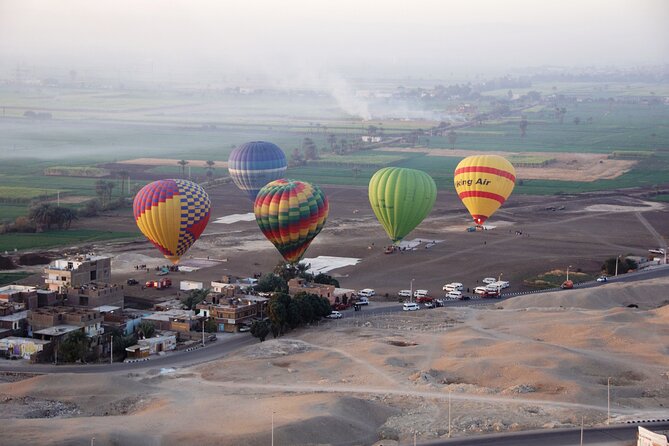
Luxor’s west bank begins before breakfast. Pickup is around 5:00 a.m. for a balloon flight lasting roughly 35 to 45 minutes. From above, you see the Nile, the fields, the mountains, and the major temples as the sun comes up.
This is not just a scenic extra. The west bank has a clear geographic pattern: fertile land near the river, dry hills farther back, and ancient tombs cut into the rocky slopes. From a balloon, that layout becomes easy to understand. You also get a calm view of Luxor before the heat builds.
A balloon ride depends on operating conditions, and the published details do not state what happens if a flight is canceled or delayed. Ask about the backup plan before you book if this experience is a top reason for choosing the tour.
The early pickup also affects the rest of your day. You go from the balloon to the Valley of the Kings, Hatshepsut’s Temple, and the Colossi of Memnon. You will see a great deal, but you should not expect a slow morning.
Valley of the Kings and Hatshepsut’s Temple
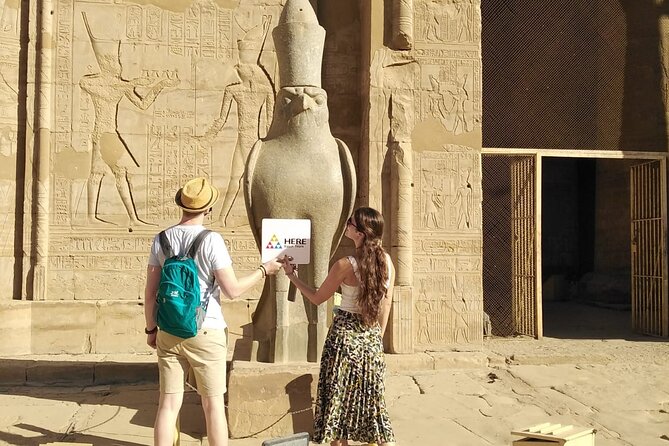
The Valley of the Kings contains more than 60 known royal tombs carved into the mountain cliffs. The tour includes the valley, though the entrance policy for individual tombs is not specified. That matters because the standard ticket may not cover every tomb, and the most famous chambers can require an extra fee.
Your guide can help you make sense of the painted walls and burial plans. The tombs are not all alike, and your experience depends on which ones are open on the day of your visit. Bring water and follow the guide’s advice about the heat, since the valley has little shade.
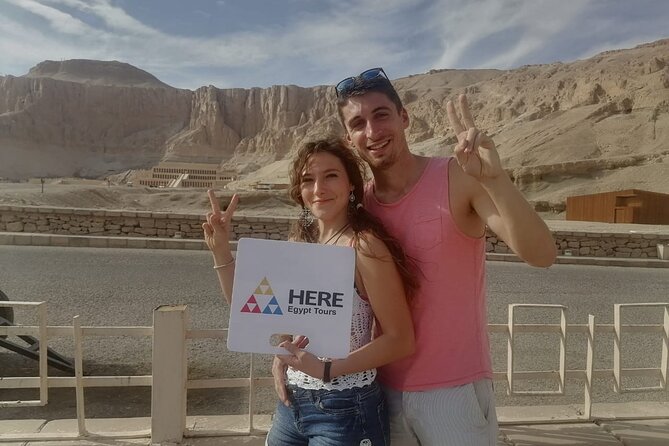
Next comes the temple of Queen Hatshepsut. Its broad terraces rise against the cliffs, creating a strong contrast with the enclosed tombs. Hatshepsut ruled as pharaoh, and her temple gives your guide a good chance to explain her unusual position and the imagery used to support her authority.
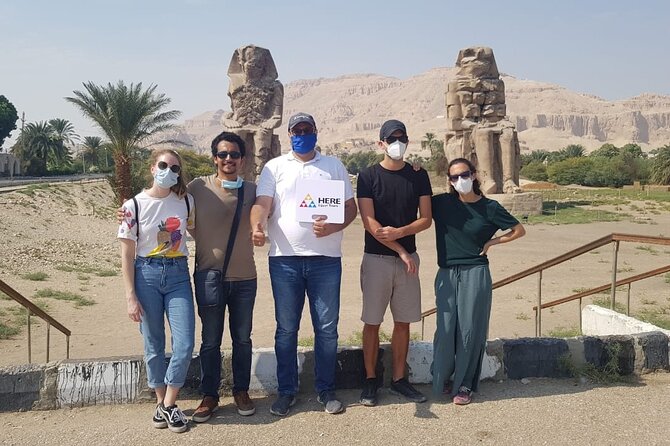
The Colossi of Memnon are a quick but worthwhile stop. These huge statues are the remaining figures from the funerary temple of Amenophis III. The site is open and easy to photograph, but do not expect a complete temple complex. The appeal is scale and setting, along with the reminder that much of the original structure has disappeared.
Lunch, tea, and daily life in Luxor
After the west bank sites, you return to the east bank for a local lunch. The meal takes place in a public house, with the stated aim of showing you how families live and giving you an idea of local traditions and customs.
You also have Egyptian tea inside a house and time for photographs. This is the most direct cultural stop in Luxor, much like the Nubian family visit in Aswan. It breaks up the sequence of tombs and temples with a look at present-day life.
I value this part because ancient Egypt can become a blur after several large monuments in a row. A home visit gives you a chance to talk, observe, and reset before the final temple. You should remember that it is still arranged as part of a tour, so the experience will be brief rather than a full day with a local family.
Lunch in Luxor is included. The package also lists two breakfasts and two lunches overall, covering the Aswan and Luxor touring days. Tips are not included, so keep small cash available for guides, drivers, and service staff if you choose to tip.
Karnak closes the sightseeing day
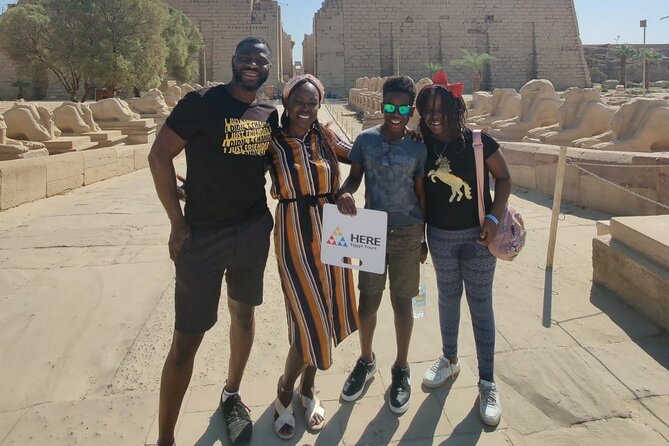
The last major sight is Karnak Temple on Luxor’s east bank. It is one of Egypt’s largest temple complexes, with massive columns, open courts, obelisks, and carved walls spread over a broad area.
Karnak can feel overwhelming without a plan. Let your Egyptologist guide lead you through the main spaces and explain how different rulers added to the complex over many centuries. The Great Hypostyle Hall, with its forest of columns, is the kind of place that makes scale more important than any single statue.
This is a long final day. You have already flown in a balloon, visited three west bank sites, eaten lunch, and then crossed to Karnak. Wear practical shoes and save some energy for the walk through the complex.
After Karnak, you go to Luxor station for the overnight train back to Cairo. You arrive at Cairo station on the final day, where the representative meets you and transfers you to your hotel or the airport, according to your request.
What the $685 price really covers
At $685 per person, the price is easiest to judge as a bundled private trip rather than a simple three-day tour. It includes door-to-door transfers from Cairo or Giza, first-class train tickets for Cairo to Aswan, Aswan to Luxor, and Luxor to Cairo, two hotel nights, guides, the balloon ride, Abu Simbel, local transport, two lunches, and two breakfasts.
That is a strong amount of transport and coordination in one package. You are not separately arranging the long rail route, station pickups, hotels, or the southern Egypt excursions. For a private experience, the convenience has real value.
The important extra cost is entrance fees. They are not included, despite the tour covering the sites listed in the schedule. Before booking, ask for the current entrance-fee total for Abu Simbel, Philae, the Valley of the Kings, Hatshepsut’s Temple, the Colossi area, Karnak, and any optional tombs.
Tips are also excluded. Group discounts are offered, and the exact saving depends on the size of your party. Since only your group participates, the per-person cost may make more sense for families or friends than for a solo booker.
Who should choose this Egypt itinerary?
I would choose this route if you have limited time in Egypt and want the major southern sights without planning the rail connections yourself. It suits people who prefer a private guide, want cultural visits as well as monuments, and are willing to trade comfort for coverage.
It is also a good fit if Abu Simbel and the Luxor balloon ride are priorities. Both can be awkward to arrange independently, and the tour places them inside a single route.
I would hesitate if you need relaxed mornings, dislike overnight trains, or want long visits at each monument. The schedule is tightly packed, especially after Abu Simbel and during the balloon morning. You also need to budget separately for entrance tickets and tips.
The tour has a 5.0 rating from three published reviews. The strongest praise centers on the four-star hotels, food, and friendly guides, with particular appreciation for the Luxor guide’s command of Egyptian history. That is encouraging, but the sample is small, so I would still confirm hotel names, train arrangements, entrance costs, and the balloon cancellation plan before paying.
Should you book it?
Book this experience if your goal is maximum coverage with minimum planning. You will see Aswan’s river culture, Philae, Abu Simbel, Luxor’s royal tombs, Karnak, and modern Egyptian life in a single private journey.
Skip it if you want a gentle pace or need every expense included. The $685 price is reasonable for the transport, hotel nights, guides, meals, and balloon ride, but entrance fees remain outside the package. For an ambitious first visit to Upper Egypt, I think the route offers good value, provided you arrive ready for early alarms and overnight trains.
FAQ
How long does the experience last?
The full journey lasts approximately five days. It includes three main sightseeing days, two overnight train rides, one night in Aswan, and one night in Luxor.
Where does the tour start?
Pickup begins around 7:00 p.m. from your hotel in Cairo or Giza, depending on its location. You are then transferred to Cairo train station.
Are the train tickets included?
Yes. First-class train tickets are included for Cairo to Aswan, Aswan to Luxor, and Luxor to Cairo.
How many hotel nights are included?
Two hotel nights are included: one night in a four-star hotel in Aswan and one night in a four-star hotel in Luxor. Breakfast is included at both hotels.
Is Abu Simbel included?
Yes. The tour includes the Abu Simbel trip from Aswan, with a visit to the temples of Ramesses II and Queen Nefertari.
Are entrance fees included?
No. Entrance fees are not included in the listed price. Tips are also excluded.
Can I cancel for a full refund?
Yes, if you cancel at least 24 hours before the experience start time. Cancellations or changes made less than 24 hours before the start time are not refunded or accepted.
Just added for rail travellers in Egypt
- Aswan, Edfu, and Kom Ombo Private Full-Day Tour from Luxor by Road and Rail★ 5.0 · 3 reviews
- Egypt Holiday 8-Days 7-Nights Cairo,Aswan,Luxor and Nile Cruise by Sleeper Train★ 3.5 · 4 reviews
- Top Day Tour To Cairo By Sleeping Train★ 5.0 · 4 reviews
- Amazing 4 Days Nile Cruise Luxor,Aswan.Abu Simbel with sleeping Train from Cairo★ 5.0 · 2 reviews
- 2-Day Private Tours to Luxor and Dendera from Cairo by Sleeper Train★ 5.0 · 3 reviews
- Luxor Day Tour by Sleeper Train★ 5.0 · 3 reviews
- 10 Day Around Egypt to Cairo ,Giza ,White desert ,Nile Cruise With Train & Hotel★ 5.0 · 5 reviews
- Full day Luxor tour from Cairo by a sleeper train★ 5.0 · 5 reviews
3-Day Experiences, compared.

3-Day Isle of Skye, ‘Hogwarts Express’ Train and Highlands Tour
Read our review →
3-Day Blarney Castle, Ring of Kerry, & Cliffs of Moher Rail tour
Read our review →
Isle of Skye & Optional Jacobite Train 3-Day Tour
Read our review →
3 Day Isle of Skye and Jacobite Steam Train Tour from Inverness
Read our review →
Colombo/Negombo: Sigiriya, Kandy, Ella 3-Day Trip with Train
Read our review →
Sapa: 3-Day, 3-Night Trek and Hotel with Overnight Train
Read our review →
Edinburgh, Loch Ness, The Highlands from London – 3 Day Rail Tour
Read our review →
Browse the lists this tour appears in