
Review · 3-DAY EXPERIENCES
Private Train Tour: 3-Day Golden Triangle Delhi, Agra, Jaipur from Delhi
The Taj Mahal is the headline, but the smart idea here is the route itself: Delhi by private car, Agra by fast train, and Jaipur by road and rail. In three days, you cover the classic Golden Triangle without having to arrange separate hotels, tickets, transfers, guides, and station connections.
I like the door-to-door service and the private format, which let you adjust the pace or skip a stop if Delhi heat, jet lag, or sheer monument overload catches up with you. I also like the mix of grand Mughal buildings, Sikh religious life, Rajput palaces, and train travel. The catch is the schedule: early starts, long transfer days, and a lot of sightseeing packed into a short visit.
Key points to know before booking
- Two fast train journeys connect Delhi with Agra and Jaipur with Delhi, including breakfast or dinner on board.
- The Taj Mahal and Agra Fort receive a proper visit on day two, not just a quick photo stop.
- Jaipur’s Amber Fort, City Palace, and Jantar Mantar are included, with short photo stops at Jal Mahal and Hawa Mahal.
- Private guides and a private air-conditioned vehicle give you more control than a large group tour.
- Two hotel nights, entrance fees, train tickets, breakfasts, and selected meals are included when you choose the hotel option.
- The pace is demanding, especially with the 6 a.m. train from Delhi and the late return from Jaipur.
Why this three-day Golden Triangle route works
India’s Golden Triangle links Delhi, Agra, and Jaipur in a compact circuit. Each city offers a different chapter. Delhi gives you imperial tombs, towering minarets, government avenues, and a living Sikh place of worship. Agra is Mughal India at its most famous. Jaipur brings Rajput forts, royal courtyards, and astronomical instruments built on a grand scale.
The value here is not only the number of sights. It is the practical handling of a complicated route. You have station assistance, a private vehicle between sights, local guides, entrance fees, and hotel arrangements in one package. That matters in India, where crossing a city or finding the correct railway entrance can take more time than expected.
The 4.5 rating from four published reviews is a small sample, so I would not treat it as final proof. Still, the strongest praise points to the service that matters most on a tight itinerary: door-to-door transport, help at each train station, and the ability to alter plans. DK Shwarma is named as a driver associated with the service, while the individual city guides are not named in the available details.
More Three-Day Trips in New Delhi:
- 3-Day Isle of Skye, ‘Hogwarts Express’ Train and Highlands Tour
★ 5.0 · 972 reviews - 3-Day Blarney Castle, Ring of Kerry, & Cliffs of Moher Rail tour
★ 4.5 · 211 reviews - Edinburgh: Isle of Skye & Optional Jacobite Train 3-Day Tour
★ 4.7 · 191 reviews
Day one: Delhi from Mughal tombs to Sikh devotion
Pickup is offered from Delhi, Gurugram, or Noida. The published start time is 9 a.m., giving you a reasonable first morning if you have arrived the previous day. Delhi traffic can change transfer times, so do not judge the day by distances on a map.
Humayun’s Tomb
Humayun’s Tomb is an excellent first stop. Built for the Mughal emperor Humayun, the red sandstone and white marble monument sits within carefully arranged gardens. Its balanced proportions and geometric design prepare you for the Mughal style that reaches its most famous form at the Taj Mahal.
You have about an hour here, with admission included. Look at the building from the garden paths before entering. The full view makes sense of the strict symmetry, raised platform, arched facade, and pale marble details.
Qutub Minar
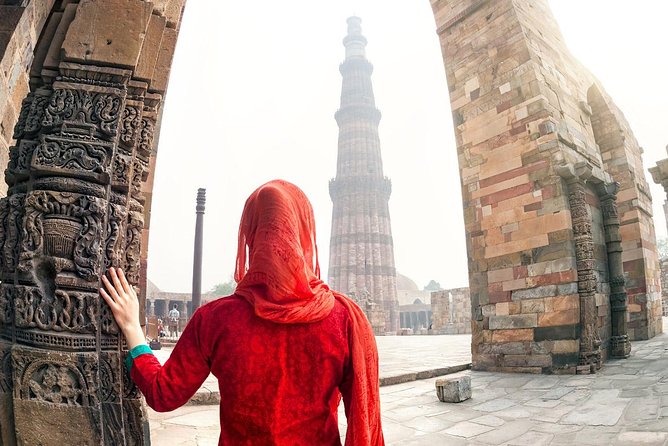
Qutub Minar gives you a different side of Delhi. The 73-meter tower rises from a complex filled with tombs, ruins, and carved architectural fragments. You have another hour, and admission is included.
This stop is valuable because it broadens the story beyond the Mughal period. Your guide can connect the tower and surrounding monuments to earlier Islamic rule in northern India. The complex is more than a single tower, so use the hour to look around rather than treating it as a quick photograph.
More Train Journeys in New Delhi:
- From Delhi: Taj Mahal & Agra Tour by Gatimaan Express Train
★ 4.8 · 1,041 reviews - Jaipur Day Trip from Delhi by Car or Train – All Inclusive
★ 5.0 · 663 reviews - “Taj Mahal” Tour from Delhi by India’s Fastest Train (Gatiman Express)
★ 5.0 · 298 reviews - From Delhi: Taj Mahal and Agra Day Tour by Super-fast Train
★ 4.9 · 270 reviews
Lotus Temple and India Gate
The Lotus Temple is designed as a quiet place for prayer and meditation. Its 27 white marble petals form a flower-like building, and people of different faiths may enter for silent reflection. Admission is free, but the temple is closed every Monday, so the weekly schedule matters when you choose your dates.
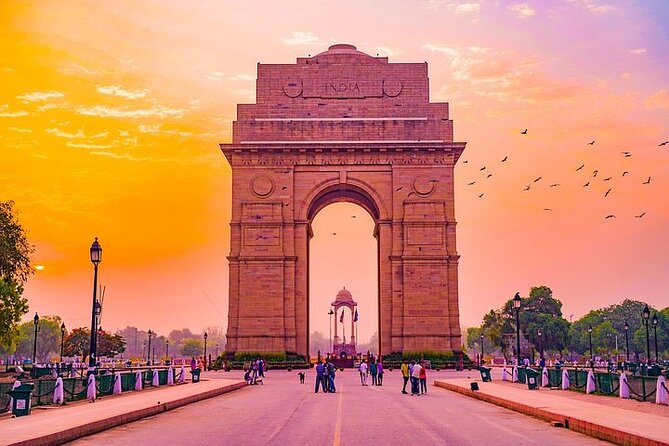
India Gate changes the mood again. The 42-meter memorial honors around 90,000 Indian soldiers connected with the First World War, operations on the Northwest Frontier, and the 1919 Anglo-Afghan War. You have about 30 minutes here, enough for photographs and a short explanation from your guide.
The route also passes the Parliament building and Rashtrapati Bhavan, the President’s House. These are important government buildings rather than standard interior visits on this program. Rashtrapati Bhavan was formerly the British viceroy’s residence and contains 340 rooms and 2.5 kilometers of corridors, but do not expect a full inside tour unless your guide confirms otherwise.
Gurudwara Bangla Sahib
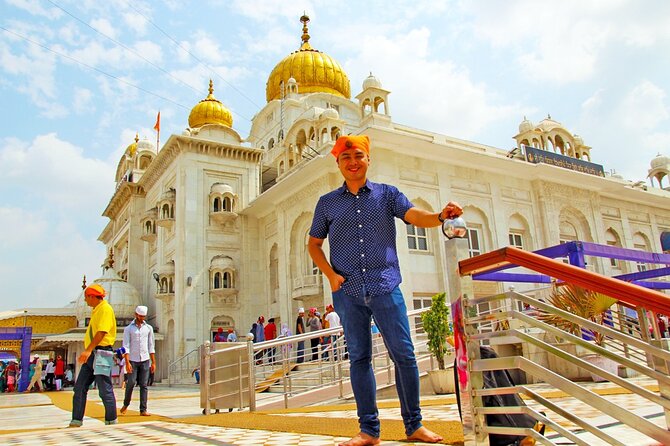
The final listed Delhi stop is Gurudwara Bangla Sahib, a Sikh temple with white marble walls and golden domes. It is a working religious place, not simply a monument. Devotional music, prayer, and the daily free meal served to pilgrims give you a chance to see faith practiced in ordinary life.
This is one of the most human stops of the day. Dress respectfully and follow the instructions about entering the gurdwara. The visit lasts about an hour and costs nothing. Afterward, you return to your hotel for the first of two nights.
Day two: the 6 a.m. train to Agra
Day two begins early. The fast train from Delhi to Agra is scheduled for approximately 6 a.m. to 8 a.m., with breakfast served on board. This is an efficient use of time, but it is not a gentle morning. If you value sleep, plan for an early night after Delhi sightseeing.
On arrival, you meet your local guide at the main exit gate. Station assistance and private transfers are included, which removes one of the most awkward parts of independent train travel. Your vehicle then handles the short city transfers between the major sights.
The Taj Mahal
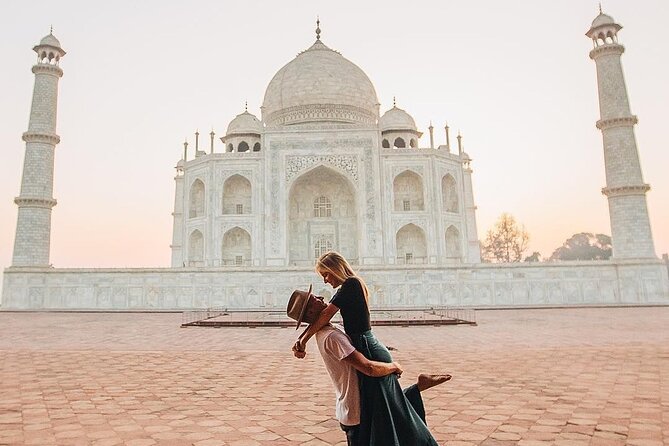
You receive about two hours at the Taj Mahal, with admission and the battery bus or e-rickshaw ride from the parking area included. The access vehicle matters because regular vehicles do not drive right up to the monument entrance.
The building was commissioned by Shah Jahan as a memorial to his wife Mumtaz Mahal, who died in 1631 after giving birth to their 14th child. That personal story gives the white marble monument more meaning than its familiar photographs suggest.
Use your time for more than the front view. Notice the changing color of the marble, the symmetry of the gardens, the calligraphy, and the way the four minarets frame the central dome. Your guide can help with the details, but you should also protect a few quiet minutes to look without a running commentary.
The Taj Mahal can be the busiest and most emotionally charged part of the tour. Two hours is enough for a solid visit, though it may feel short if you want every courtyard, angle, and architectural detail. Camera fees at monuments are not included, so ask your guide about current rules before taking specialist equipment.
Agra Fort
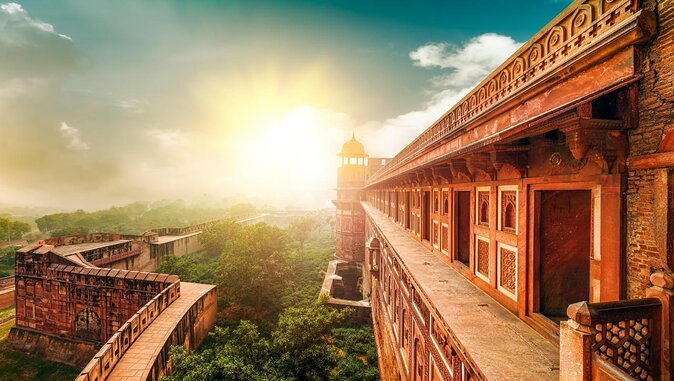
Agra Fort follows the Taj Mahal and gives you the political setting behind the monument. The red sandstone fort beside the Yamuna River was the main residence of Mughal emperors until 1638. Inside are defensive walls, courtyards, audience spaces, and palace buildings.
The visit lasts about an hour, with admission included. I find this stop especially useful after the Taj Mahal because it shifts the focus from one royal memorial to the larger Mughal court. The fort also helps explain the power, wealth, and family politics behind the empire.
You should expect some walking and steps. Comfortable shoes will help, especially after the morning at the Taj Mahal.
The road from Agra to Jaipur
After Agra Fort, you drive to Jaipur. The transfer is listed at about five hours, though actual time depends on traffic and road conditions. This is the longest road section of the trip and the main reason the schedule can feel intense.
You check into the pre-booked Jaipur hotel on arrival. Two nights of accommodation with breakfast are included when you select the hotel option, based on twin sharing. Clarify the hotel category and room arrangement before booking if those details affect your decision.
The road transfer is not sightseeing time in the same way as the monuments. It is simply the link that makes the three-city circuit possible. I would use it to rest, organize photographs, and save energy for Jaipur’s early start.
Day three: Amber Fort and Jaipur’s royal center
After breakfast, you check out and begin with Amber Fort. This is a full day of sightseeing followed by an evening train, so keep your bags organized and do not plan on a relaxed afternoon at the hotel.
Amber Fort
Amber Fort, also called Amer, rises on a rocky hillside about 11 kilometers northeast of Jaipur. Its pale yellow and pink sandstone, white marble, courtyards, gates, and palace rooms show how Rajput design developed alongside Mughal influence.
You have about two hours here, with admission included. That is enough time to understand the four main sections and enjoy the views from the hilltop complex. The fort is the architectural high point of Jaipur’s program.
Elephant or jeep rides at Amber Fort are not included. Do not assume the tour price covers one. The included sightseeing takes you to the fort, while any optional ride is an extra cost and should be arranged separately if available.
Jal Mahal and Hawa Mahal
Jal Mahal is a 15-minute photo stop beside Man Sagar Lake. The palace appears to float in the water, and the short visit is designed for an exterior view rather than a full palace tour.
Hawa Mahal, the Palace of Winds, receives another 15-minute photo stop. Its pink honeycomb facade rises five stories and was built in 1799 so women of the royal household could watch city life and processions from screened windows. Admission is not included here, which fits the short exterior stop.
These two places are useful pauses between longer visits. Do not expect extensive exploration. You will see the landmarks, take photographs, and move on.
City Palace and Jantar Mantar
The City Palace takes about an hour. It remains connected with Jaipur’s royal family and combines courtyards, gardens, and buildings from several periods. The architecture mixes Rajasthani and Mughal features, making it a good place to compare the styles you have seen in Agra and Amber.
Jantar Mantar is more unusual. This UNESCO-listed observatory contains huge geometric instruments calibrated to track the movement of stars and planets. Admission is included, and you have about an hour.
You will get more from Jantar Mantar with a guide who explains what each instrument measured. Without context, the curved walls and oversized structures can look abstract. With an explanation, the site becomes a practical record of how rulers used mathematics and astronomy.
The return train and what the timing means
In the evening, you transfer to Jaipur railway station for the scheduled train to Delhi, approximately 5:50 p.m. to 10:40 p.m. Dinner is served on board. At Delhi station, a representative meets you and takes you to your hotel or another chosen destination in Delhi, Gurugram, or Noida.
This final train is convenient, but the day is long. You may leave Amber Fort in the morning, visit several Jaipur sights, and still have station transfers before a late arrival. The advantage is that you avoid another long road journey. The cost is a late finish and limited recovery time.
Train timings can change, and transfer times depend on traffic. Keep your passport with you, along with the booking information and any required travel documents. A current passport is required on the day of the tour, and passport details are needed when booking.
What the $400 price really covers
At about $400 per person, this is not a bare sightseeing ticket. The price can include two hotel nights with breakfast, private air-conditioned transport, local guides, two fast train rides, entrance fees for the listed attractions, station assistance, bottled water in the vehicle, breakfast on the Delhi to Agra train, and dinner on the Jaipur to Delhi train. A hotel-inclusive option is required for the accommodation benefits.
The package has real value for a couple or small private group that wants convenience. Buying each rail ticket, hotel, guide, car transfer, entrance ticket, and station connection separately would take time and require careful coordination. The private format also gives you the ability to alter the plan or skip a stop, a useful benefit on a crowded three-day schedule.
The price does not cover every expense. Camera fees, extra food and drinks, Amber Fort elephant or jeep rides, and anything not listed are separate. A mandatory gala dinner at the hotel on Christmas Eve or New Year’s Eve may also cost extra.
Vegetarian meals can be requested, and you should give dietary requirements when booking. The tour includes specified breakfasts and train meals, but you should not read that as all meals being covered.
Who should book this private train tour?
I would choose this experience if you have only three days and want the famous sights handled efficiently. It suits couples particularly well because the private vehicle, private guides, and flexible schedule remove some of the strain of a fast itinerary.
It also suits first-time visitors who want help with Indian railway stations and city transfers. The combination of station assistance and door-to-door service was the most useful service feature for me to consider. You are not left to work out every connection alone.
I would hesitate if you dislike early mornings, long road transfers, or tightly planned sightseeing. Delhi begins at a manageable hour, but Agra starts around 6 a.m., and the Jaipur return gets you back to Delhi close to 11 p.m. Three cities in three days means you will see the essential sights, not live slowly in each place.
The tour is private, but it is not leisurely. The best approach is to decide in advance which stops matter most to you. If you tire easily, use the flexibility to shorten a visit. If you love architecture and history, keep the full time at Humayun’s Tomb, the Taj Mahal, Agra Fort, Amber Fort, and Jantar Mantar.
Final recommendation
Book this tour if you want a well-organized first look at Delhi, Agra, and Jaipur and place a high value on private transport, guides, and train support. The Taj Mahal, Agra Fort, Amber Fort, City Palace, and Jantar Mantar make the price easier to justify, especially with hotels and entrance fees included.
Skip it if you want long mornings, unplanned wandering, or several quiet nights in one city. For a short visit, though, the route is practical, the private format gives you useful control, and the rail connections save valuable road time.
FAQ
What cities does the tour visit?
The tour visits Delhi, Agra, and Jaipur. It begins and ends in Delhi, with pickup and final drop-off available in Delhi, Gurugram, or Noida.
How long is the tour?
The experience lasts approximately three days and includes two nights of hotel accommodation when you choose the hotel-inclusive option.
Are train tickets included?
Yes. The tour includes fast deluxe train journeys from Delhi to Agra and from Jaipur to Delhi. Breakfast is served on the morning train, and dinner is served on the evening return train.
Is the Taj Mahal entrance fee included?
Yes. Entrance fees for the listed sights are included, including the Taj Mahal. Camera fees are not included.
Is a vegetarian meal available?
Yes. A vegetarian meal option is available. You should provide dietary requirements when booking.
Can I cancel for a full refund?
Yes, if you cancel at least three full days before the experience start time. Cancellations made less than three full days before the start time are not refunded, and late changes are not accepted.
Just added for rail travellers in New Delhi
- Taj Mahal & Agra Tour From Delhi By Fastest Train★ 5.0 · 7 reviews
- Private Tajmahal Day Tour From New Delhi By Gatiman Express Train★ 5.0 · 14 reviews
- Taj Mahal and Agra Fort Tour By Fastest Train – Gatiman Express★ 5.0 · 2 reviews
- Taj Mahal and Agra Tour By India’s Fastest Train★ 5.0 · 2 reviews
- From Delhi: Taj Mahal & Agra Tour by Gatimaan Express Train★ 5.0 · 11 reviews
- Enchanting Taj Mahal Same Day Tour by Gatiman Train From Delhi★ 5.0 · 4 reviews
- Taj Mahal Tour by Gatimaan Express Train With Lunch At 5 Star Hotel★ 5.0 · 8 reviews
- Taj Mahal & Agra Fort Visit by Gatimaan Express Train★ 5.0 · 4 reviews
3-Day Experiences, compared.

3-Day Isle of Skye, ‘Hogwarts Express’ Train and Highlands Tour
Read our review →
3-Day Blarney Castle, Ring of Kerry, & Cliffs of Moher Rail tour
Read our review →
Isle of Skye & Optional Jacobite Train 3-Day Tour
Read our review →
3 Day Isle of Skye and Jacobite Steam Train Tour from Inverness
Read our review →
Colombo/Negombo: Sigiriya, Kandy, Ella 3-Day Trip with Train
Read our review →
Sapa: 3-Day, 3-Night Trek and Hotel with Overnight Train
Read our review →
Edinburgh, Loch Ness, The Highlands from London – 3 Day Rail Tour
Read our review →
Browse the lists this tour appears in